
Mixture of Experts (MoE) is a model architecture that combines several learned neural-network components, called experts, using a routing mechanism. In a sparse MoE, only a subset of the available experts processes each input. This lets a model increase its total parameter capacity without increasing computation in direct proportion.
For language models, that selection commonly happens for each token at each MoE layer. A token is a piece of text, such as a word fragment or punctuation mark. This article focuses on that widely used sparse design; not every architecture described as a mixture uses sparse routing. Sparsely-gated MoE research
New to language models? Start with Large language models (LLMs) explained for the basics of tokens, training, and text generation.
What an expert actually is
In many transformer language models, experts replace a layer’s usual feed-forward network: the component that transforms a token’s internal numerical representation. A dense layer applies the same feed-forward network to each token; a sparse MoE layer chooses among several alternatives. Other components, including attention, can remain shared. An expert produces intermediate numbers, not a complete answer to the user.
The name can suggest a panel of professionals, but learned experts do not necessarily correspond to subjects such as law, coding, or finance. Mixtral’s routing analysis found patterns associated with syntax and token position rather than a simple expert-per-topic division. A prompt asking for a “coding expert” does not directly select a numbered internal expert. Mixtral architecture and routing analysis
How routing works
A common top-k routing design follows four steps:
- Read a token’s representation. Earlier computations have already incorporated information from its context.
- Score the experts. A learned router, also called a gate, chooses a small number of experts. Here, k means how many are selected.
- Run the selected experts. Each chosen network transforms that representation.
- Combine their outputs. Routing weights determine their contributions to the layer’s result, which continues through the model.
The selection can change at the next layer or token. It is not usually one decision that assigns the whole conversation to a single expert. Mixtral’s top-2 routing
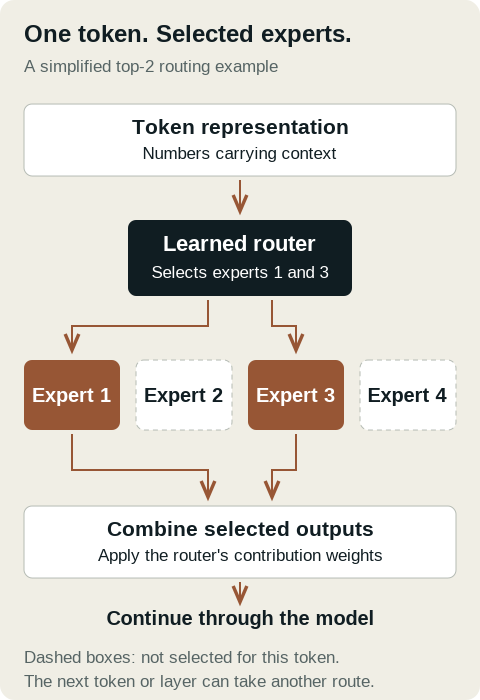
This is a simplified example, not a specific model’s layout. Some designs also have shared experts that run alongside the selected experts. DeepSeek-V3 is one documented example. DeepSeek-V3 architecture
Total parameters, active parameters, and memory
Total parameters count the model’s stored learned values. Active parameters per token describe the portion used along that token’s computation path, including relevant shared components. Read the model’s counting conventions; the active count is not simply the total divided by the number of experts.
Consider this deliberately simplified example, with equally sized expert components and routing overhead ignored:
Shared parameters:                    2 billion
Expert parameters:       8 experts × 1 billion
Experts selected per token:           2

Total parameters:         2 + 8 × 1 = 10 billion
Active parameters:        2 + 2 × 1 =  4 billion
At 16 bits per parameter, storing those 10 billion parameters takes about 20 GB in decimal units before overhead. Using four billion per token does not turn the checkpoint into an 8 GB model. These figures illustrate the distinction; they are not a hardware specification.
The full collection of weights still needs to be available somewhere. A runtime may distribute experts across devices or offload weights to other memory, but moving data can add delay. Context caches, buffers, and concurrent requests need additional memory. See AI model parameters and quantization for the related storage considerations.
Why use MoE?
The main benefit is more learned capacity for a given amount of active computation. That creates opportunities to improve quality or efficiency, depending on the training and serving setup.
| Potential benefit | What it can mean in practice |
|---|---|
| More capacity without activating every expert | A model can learn with a larger parameter pool while limiting the work done for each token. |
| Better use of a training compute budget | Sparse models can reach useful quality with less computation than a particular dense baseline. |
| More efficient serving | Suitable hardware, batching, and optimized routing can turn computational savings into higher throughput or lower cost. |
Switch Transformer research demonstrated training-efficiency gains and improvements in multilingual experiments. Those results establish that sparse designs can be useful; they do not guarantee the same improvement for every model or workload. Switch Transformers
Always specify the comparison. “Less computation than a dense model with the same total parameter count” is different from “faster than a much smaller dense model” or “cheaper at the same measured quality.” An active-parameter ratio alone cannot establish any of those outcomes.
The trade-offs
Sparse computation brings engineering work. During training, experts and routing are learned together. If routing concentrates too heavily on a few experts, others can receive too little training. Load-balancing methods help spread the work. MoE training and utilization
At deployment time, experts spread across accelerators must receive token representations and return results. Communication, uneven workloads, and memory access can offset arithmetic savings. DeepSeek-V3’s report describes substantial engineering around these costs. Its particular infrastructure is an example, not a minimum requirement for every MoE model. DeepSeek-V3 serving design
For a user choosing a model, the practical checks are:
- Memory: can the full model and the intended context fit in the chosen setup?
- Responsiveness: how long until the first token, and until the complete useful answer?
- Throughput: how many requests can the service handle at the required response time?
- Quality: does the model pass representative tasks, including difficult cases?
- Cost: what is the cost per successfully completed task, including retries and review?
MoE does not itself prevent hallucinations, guarantee privacy, or make a model knowledgeable about your current business policies.
Where MoE can be useful
The following are application scenarios to evaluate, not capabilities guaranteed by the architecture. A suitable dense model can also perform these tasks.
| Use case | Why evaluate an MoE model? | What to test |
|---|---|---|
| Customer support and internal assistants | A shared service may need broad language and task coverage while handling many requests. | Policy accuracy, appropriate handoffs, response time under load, and cost per resolved task. |
| Multilingual writing and summarization | A model trained across languages may offer useful quality with limited active computation. | Meaning preservation, terminology, and performance in each required language. |
| Coding assistance | A capable code-trained MoE may be useful for explanations, edits, and test generation. | Executable tests, repository conventions, and time to a correct result. |
| Document question answering | An MoE can be the language model inside a retrieval-augmented generation system. | Evidence support, citation accuracy, and behavior when the source is missing. |
| Local experimentation | A smaller MoE may offer an appealing quality and speed combination when its full weights fit. | Model-format support, memory use, offloading, and performance on the actual device. |
For example, a support team could compare a dense model and an MoE on the same redacted questions and approved policy passages. Score incorrect claims, omissions, and escalation decisions with the AI MQM toolkit, then measure response time under realistic traffic. Choose the model that meets the team’s quality and operating requirements.
Recognizable examples
These are documented architecture examples, not a ranking or a list of the newest releases. B means billion parameters. Counts below follow the cited authors’ reporting and rounding.
| Model | Total parameters | Active per token | What it illustrates |
|---|---|---|---|
| Mixtral 8x7B | About 47B | About 13B | Two of eight experts are selected in each MoE layer; its name does not mean eight independent chatbots. |
| Qwen3-30B-A3B | 30.5B | 3.3B | The model card lists 128 experts and eight activated; the name rounds the parameter counts. |
| DeepSeek-V3 | 671B | 37B | A large total count can coexist with a much smaller active count and shared expert components. |
Qwen’s release includes both dense and MoE models. A family name alone therefore does not establish the architecture of a particular checkpoint. Verify the exact model card and your runtime’s support before planning a download. Qwen3 model family
How MoE fits with other AI ideas
MoE describes computation inside the model. A multi-agent system coordinates separate task-performing components. An application-level model router chooses between complete models or services. Those are different architectural decisions from selecting internal experts.
RAG supplies external evidence; it can work with either a dense or an MoE language model. Quantization changes numerical precision and can reduce weight storage. Distillation trains a student using a teacher’s signals. These techniques can be combined, but none is another name for MoE.
Check your understanding
A model has 30B total parameters and 3B active. Should you budget memory for only 3B?
No. The total weights still need to be available, even if a runtime stores them across devices or offloads some of them. You also need room for caches and runtime overhead. Active parameters describe computation, not the full memory requirement.
Does a model with eight experts contain eight named subject specialists?
No. In the sparse transformer design described here, experts are learned neural-network components. Their behavior can overlap, and their selection can change by token and layer. The architecture does not promise one expert for each human-defined subject.
Can an MoE use both RAG and quantization?
Yes. RAG supplies external information, quantization changes numerical representation, and MoE changes which internal expert components run. Compatibility and the final quality still need to be checked for the specific model and implementation.